
Simple Shear through ECAE leads to Powerful Results
|
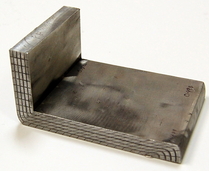
At SFI, we specialize in improving material performance using severe plastic deformation. Our tooling designs and materials expertise allow us to push the boundaries of bulk material properties. We are also a full-service engineering firm, offering mechanical and materials design and analysis consulting services from our staff scientists and licensed Professional Engineers. |
Materials Processing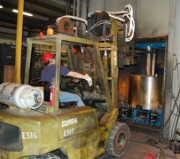
We can ECAE process square and round billets, plates, and tubes to achieve extreme levels of plastic strain in bulk material. We currently process round solid sections up to 3" diameter and 24" long, and square cross section billets up to 2" square and 10" long. We also offer conventional forming methods and atmospheric or ultra-high vacuum heat treatment.
|
Research and Development Assistance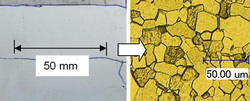
SFI has a PhD and PE metallurgists/materials scientists and engineers on staff. Our combined expertise includes design of experiments, deformation processing, materials characterization, and equipment/fixture design and simulation. Let us help you develop and improve your products.
|
Consulting
Shear Form, Inc. has two licensed Professional Engineers (P.E.s) on staff, as well as highly qualified and capable engineers and scientists. We can help with your metal processing, engineering, and design needs. Our experience with failure analysis ranges from component re-design to litigation.
|
Prototyping and UHV Heat Treatment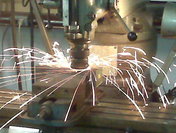
We have in-house machining, welding, surface grinding, rolling, forming, extrusion, and vacuum heat treatment capabilities at our disposal. While these primarily serve to support our material and tooling production, we can bring your designs to life with one-off and short-run components.
|
Case Studies
While many of our projects are for commercial clients, others serve as an example of what our expertise in deformation processing can do for the manufacturability and performance of a wide range of products.
Breaking Barriers
|
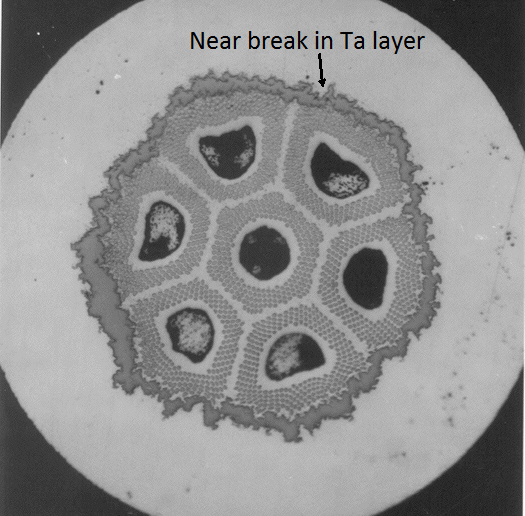
The Problem
The current density of Nb3Sn superconductors is critical to device performance in many high-magnetic-field applications such as NMR. Pictured here is a 9mm diameter wire that began as a thick-walled Cu tube with a stack of Nb and Sn bars arranged on the interior before being extruded and drawn down. Separating the internal and external components is a Ta sheet preventing Sn contamination of the Cu when the strand is heated to react the Nb and Sn. A break in this barrier can destroy the properties of a conductor and reduce painstakingly created and costly strand to scrap. Given the need to improve current density, the Ta layer should be as thin as possible. However, manufacturing yield requires thick Ta to limit the risk of breaks. A dramatic improvement to Ta barrier co-deformation during conductor drawing would allow for thinner Ta sheet, a lower rejection rate, and, in the end, higher magnetic fields. |